
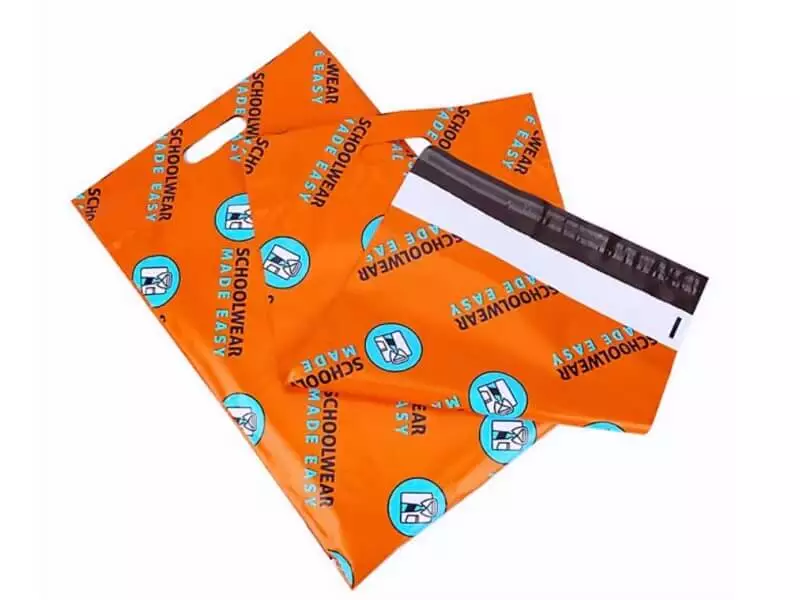
Adding handles to shipping bags seems like a small feature, but the cost implications can surprise many logistics managers and e-commerce operators. Over the years, we have helped B2B clients evaluate whether poly mailers with handles make financial sense for their specific shipping volumes and product types. Handles offer convenience for pick-up points, returns, and customer unboxing experiences, yet they introduce multiple cost variables that go far beyond a simple bag. Understanding these factors before ordering prevents budget overruns and ensures you only pay for features that truly add value. Let us break down what actually drives the price.
 Raw Material Consumption and Layer Structure
The most significant cost factor for mailing bags with handles is the additional raw material required. Standard poly mailers use a 3-layer co-extruded LDPE material—white outside, gray or black inside—which already balances strength and cost. However, handles require reinforced areas, often meaning extra LDPE layers or thicker gauge sections around the handle cut-out or attachment point. This increases material weight per bag, and since suppliers price by weight or square footage, your per-unit cost rises accordingly. Moreover, poly mailers with handles typically need larger blank dimensions to accommodate the handle shape without compromising the sealed area. We have seen handle designs add 15-25% more material compared to handle-less versions of the same bag size. For businesses shipping thousands of bags monthly, that percentage translates directly into a significant line item.
Manufacturing Complexity and Production Speed
Not all mailing bags with handles are created equal during production. Die-cut handles (punched directly into the bag) require custom tooling and slower production line speeds because the punching step adds cycle time. Reinforced handles with heat-sealed edges or extra patches demand additional labor and quality control checks. As a source factory managing full production, we know that any deviation from standard bag manufacturing introduces setup costs, tooling amortization, and potential waste during calibration. For smaller order quantities, these fixed costs get spread over fewer units, making poly mailers with handles considerably more expensive per piece. Conversely, large wholesale orders allow us to optimize the die-cutting and sealing processes, bringing the premium down to a more modest percentage.
Customization and Printing Considerations
When you order mailing bags with handles that also feature custom branding, costs multiply. Printing around handle cut-outs requires precise registration to avoid misaligned logos or cropped designs. The handle area itself cannot hold ink, so design layouts must be adjusted, sometimes requiring larger printable surfaces or secondary printing passes. Additionally, poly mailers with handles often need stronger seal integrity near the handle to prevent tearing during transit. This might mean upgraded adhesives or longer sealing times, both adding to production expenses. We always advise clients to test handle placement with their artwork before finalizing orders.
Evaluating the True Return on Handles
Poly mailers with handles deliver real value for certain applications—retail pick-up, subscription boxes, or customer returns where carrying convenience matters. But that value must outweigh the added material, tooling, and production complexity. At WH Packing, we manufacture mailing bags with handles using premium 3-layer co-extruded LDPE material, white outside and gray or black inside, ideal for apparel, shoes, books, cosmetics, supplements, and more. With strong production capacity, complete customization, ISO and QC assurance, and solid delivery guarantees, we help you calculate exactly whether handles make financial sense for your operation. Contact us for your poly mailers with handles wholesale needs and let us build the right cost structure together.