
Global commerce relies heavily on secure packaging to protect clothing items during transport. As environmental regulations tighten and consumer awareness rises, procurement managers face a critical question: are apparel shipping bags truly recyclable or sustainable? The quick answer is yes, but the path to achieving genuine sustainability depends heavily on material composition, sorting infrastructure, and the expertise of your manufacturing partner. B2B buyers must navigate complex industry standards to avoid greenwashing while maintaining operational efficiency. Choosing a partner like WH Packing helps enterprises bridge the gap between high-performance protective mailers and strict environmental compliance.
Unpacking Sustainable Materials: From GRS to Biodegradable Films
To make an informed purchasing decision, it helps to understand the distinct polymer technologies driving modern courier packaging. The days of basic, non-recyclable single-use plastics are rapidly ending. Today, professional manufacturers utilize Global Recycled Standard (GRS) certified resins to create highly reliable, circular packaging options. Operating with over 15 years of industry specialization, high-quality factories control the entire manufacturing process starting from raw material procurement to final bag production. This complete control guarantees raw material purity and certified environmental performance.
These specialized packaging materials generally fall into three main ecological categories:
Pre-Consumer Recycled Materials: Sourced directly from clean industrial waste generated during the extrusion process. Reusing these scraps prevents high-quality polymer compounds from reaching landfills. It also ensures excellent mechanical strength because the plastic has not been degraded by consumer use or external environmental elements.
Post-Consumer Recycled Materials (PCR): This category utilizes plastic waste recovered from domestic and commercial recycling streams. Integrating PCR is highly effective for reducing carbon footprints and cutting down on petroleum dependence. However, it requires advanced co-extrusion technology to maintain structural integrity and prevent issues like odor or textural inconsistency.
Fully Biodegradable Materials: Often constructed from PBAT and PLA blends, these bags break down into organic compounds under certified composting conditions. This option is exceptionally popular in markets like Australia and Western Europe, where local green initiatives favor biodegradable alternatives over traditional plastic structures.
Structural Integrity and Recycling of Apparel Bags for Shipping
When sourcing apparel bags for shipping, durability cannot be sacrificed for environmental claims. Apparel items are highly vulnerable to moisture, dust, punctures, and tearing during long transit routes. Traditional low-density polyethylene (LDPE) mailers are highly recyclable, categorized under recycling code 4. This classification means they can be processed easily by commercial facilities or retail store recycling collection points. For large-scale distributors, using materials that consumers can easily recycle locally is a vital part of sustainable brand messaging.
The real manufacturing challenge lies in the specialized multi-layer construction. High-performance mailing bags often require a 3-layer co-extrusion process to bond different polymer layers together. This bonding creates an opaque, highly puncture-resistant barrier. A key technical requirement for sustainability is ensuring that all co-extruded layers consist of the same mono-material family. This design allows the entire bag to be melted down and pelletized in one step. If a factory mixes incompatible plastics, the bag becomes impossible to recycle commercially. For wholesale importers, specifying certified mono-material LDPE construction is the most effective way to guarantee that their shipping supplies remain fully recyclable.
Operational Advantages of Sourcing from an OEM Manufacturer
Achieving cost-effective, sustainable packaging requires a supplier with substantial industrial capacity and end-to-end quality control. Sourcing directly from an established source factory ensures both competitive pricing and stable supply lines. A massive production facility spanning 27,000 square meters, backed by a monthly capacity of 100 million units, has the operational flexibility to execute large-scale OEM and ODM orders smoothly.
Advanced machinery allows for precise material blending, ensuring that post-consumer recycled content does not compromise the bag’s tear resistance or waterproof seals. Moreover, specialized testing equipment guarantees that every production run meets rigorous ISO standards. Controlling the process from raw polymer procurement to final bag cutting eliminates mid-stream supply chain vulnerabilities. This reliable manufacturing setup guarantees delivery timelines for major logistics carriers, postal services, and international retail brands.
Maximizing Efficiency with Recycled Poly Mailers with Handles
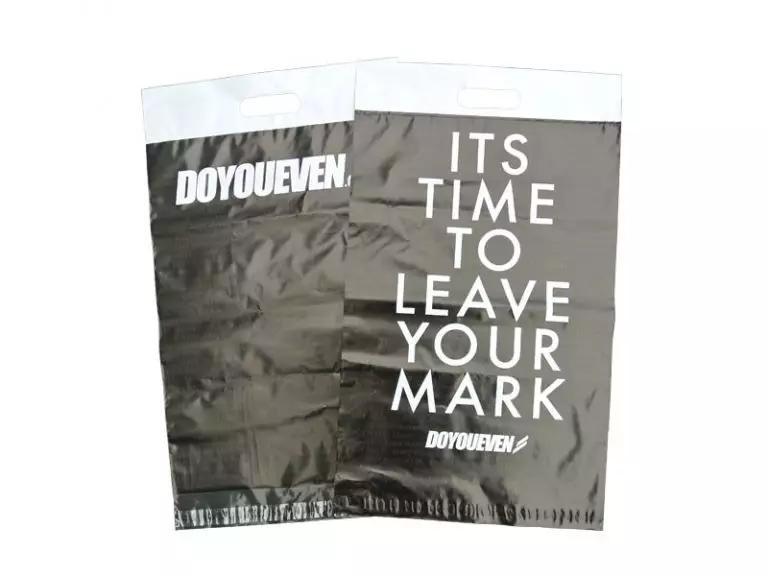
Beyond material sustainability, functional design plays a vital role in modern parcel logistics. Adding practical features to shipping mailers can significantly improve delivery handling and customer satisfaction. Specifically, utilizing customized poly mailers with handles provides an ergonomic, easy-to-carry solution for last-mile delivery drivers and retail consumers alike.
These integrated handles require precision die-cutting and reinforcement during the high-speed automated manufacturing process. When manufactured using GRS-certified recycled resins or biodegradable compounds, these custom configurations offer a dual benefit. They elevate the end-user experience while reinforcing a brand’s dedication to eco-friendly practices. Dual adhesive tear-strips can also be added. This feature enables seamless returns using the exact same packaging, effectively doubling the lifespan of the bag before it enters the recycling system.
Strategic Sourcing for Global E-Commerce Operations
Wholesalers, packaging distributors, and international logistics enterprises must coordinate their procurement cycles to optimize costs. High-volume runs are essential for minimizing the unit price of advanced co-extruded or compostable mailers. Setting up industrial extruders for specific recycled-content runs involves calibration and material purging, which makes small batches cost-prohibitive.
To overcome this hurdle, proactive B2B buyers should establish clear annual volume projections and coordinate production schedules. Working with a manufacturer that provides transparent, end-to-end OEM and ODM support allows you to secure stable factory pricing. Proper planning ensures that your supply chain remains robust, resilient, and fully compliant with changing regional environmental mandates.